



3 Manufacturing Problems Brands Should Understand Before Development
With tools like Midjourney and ChatGPT becoming part of the fashion development process, AI-generated handbag concepts are now common. For brands and designers, these tools are useful for exploring shapes, colors, hardware ideas, and visual direction much faster than traditional sketching alone.
But in real product development, a visually impressive AI image is not the same as a production-ready handbag design.
As a handbag manufacturer involved in development and production every day, we often receive AI-generated bag concepts from clients. Many of these designs look striking on screen, but once they enter quotation, sampling, or bulk production evaluation, the same issues tend to appear again and again: surface decoration cost, custom hardware development, and structural feasibility.
If you are planning to turn an AI handbag concept into a real product, it is important to evaluate manufacturability before sending the artwork directly to a factory. Below are three of the most common production problems brands should understand first.
1. Decorative Surface Effects Often Become the First Major Cost Problem
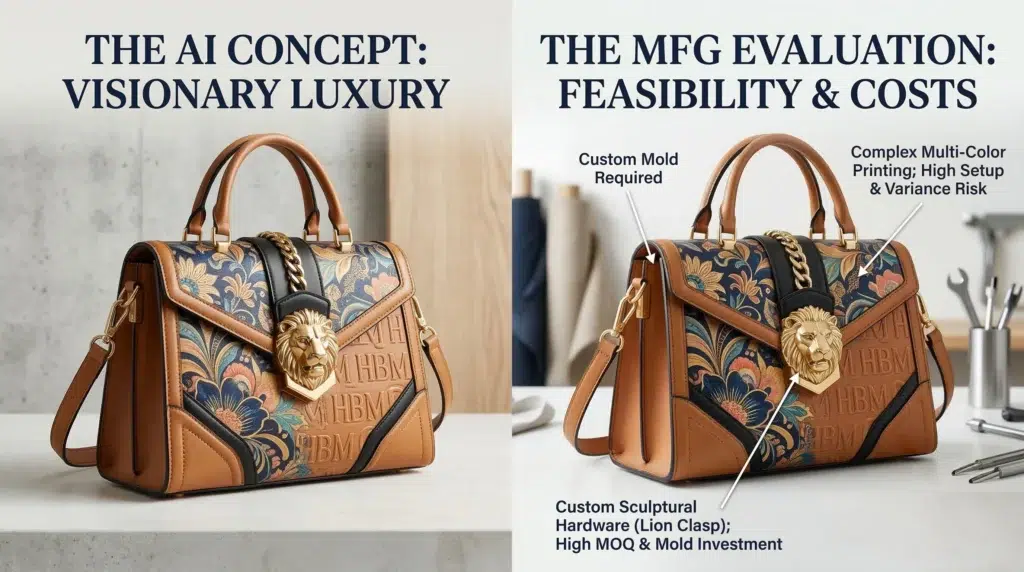
Recently, we received an AI-generated handbag concept from a U.S. client. The design looked visually strong: the body of the bag was covered with multiple irregular raised logo elements, combined with highly detailed multi-color printing. From a branding perspective, it was eye-catching and memorable. On screen, it looked like a premium fashion product.
However, once we calculated the actual production cost, the result was very different. The unit cost quickly moved beyond the client’s original retail price structure.
Why does this happen in handbag manufacturing?
AI can create embossed effects, deep texture, and layered decorative printing instantly, without considering how those effects would be achieved in a real leather goods factory.
In actual handbag manufacturing, deep tactile embossing or raised decorative effects usually require dedicated tooling. If the bag includes multiple unique raised shapes in different sizes, each one may require its own mold. For brands testing the market with a limited quantity, tooling alone can become a significant upfront development expense.
The same issue applies to complex printing. AI often generates gradient effects, multi-color layering, or vivid decorative graphics that look effortless in an image. In production, however, multi-color printing on leather or synthetic materials can involve high setup costs, more complicated alignment, and a greater risk of defects or material waste. The more complex the decoration, the more unstable the process may become during both sampling and bulk production.
What we usually recommend to brands
If the project is still in its early stage and the brand is working with a limited development budget, it is often better to control fixed upfront costs first.
For example, instead of using large areas of custom embossed decoration, brands can sometimes consider laser engraving or other lower-tooling alternatives, depending on the material and desired finish. This can preserve part of the visual identity while avoiding unnecessary mold expenses.
For printed effects, simplifying the number of colors is often a more practical choice. In many handbag projects, a strong material choice, attractive leather texture, or high-quality surface finish can create a more premium result than overly complex decorative printing.
Before sampling, confirm:
- Does the design include multiple unique raised or embossed elements?
- Will those details require separate molds?
- Can some decorative effects be replaced with lower-cost alternatives without damaging the overall design direction?
2. Unique Hardware Design Can Quietly Trigger High Tooling Costs and MOQ Problems
Among all AI-generated handbag concepts, hardware is often the area where brands most easily underestimate development cost.
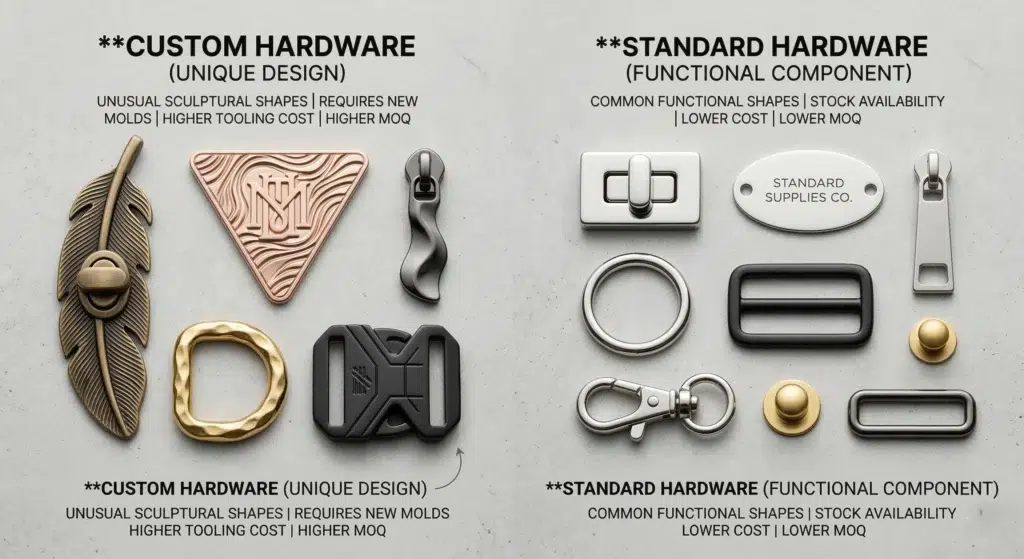
To achieve a dramatic visual effect, AI frequently generates unusual metal parts: asymmetrical buckles, non-standard strap connectors, highly sculptural zipper pullers, or even custom-shaped feet at the bottom of the bag. These details look exciting in a render, but in actual handbag production, they usually trigger one very real issue: new mold development.
Why is handbag hardware one of the biggest risk areas?
In modern handbag manufacturing, a large portion of fashion hardware is made through established die-casting systems. Standard parts such as D-rings, rectangular sliders, lobster clasps, zipper pullers, and bottom studs are widely available using existing molds. This is one reason experienced manufacturers can keep cost, quality, and lead time under control.
But when an AI-generated bag includes hardware shapes that do not already exist in the market, each custom part may require separate mold development. That means the front lock, logo plate, zipper puller, strap buckle, feet, or connectors could all become individual tooling projects.
For the brand, this does not only mean additional mold charges. It also often means a higher MOQ for custom handbag hardware. Hardware suppliers usually need enough volume to recover development cost, which can create a serious mismatch for brands that only want to produce 100 bags for market testing.
This is where many early-stage projects run into trouble. The brand may want a small production run, but the hardware strategy has already pushed the project into a cost structure designed for a much larger order.
What we usually recommend to brands
If budget or order quantity is limited, the most practical approach is to focus customization where it matters most.
In many cases, we suggest keeping only the most brand-defining hardware custom, such as the front lock, a signature logo plate, or one main decorative metal component. Meanwhile, more functional parts — including D-rings, adjustment buckles, internal zipper pullers, and connection hardware — can often be replaced with high-quality standard components.
This approach usually works well because it preserves the design identity of the bag while reducing mold cost, lowering MOQ pressure, and making the project easier to sample and scale.
In real handbag development, successful products are rarely the result of customizing every single component. They come from making smart decisions about which details truly need to carry the brand identity.
Before sampling, confirm:
- Which hardware part is truly essential to the brand identity?
- Which components are functional and could use standard molds?
- Is the projected order quantity enough to justify multiple custom hardware developments?
3. AI Images Ignore Physical Reality, but Real Handbags Must Follow Structural Logic
Another very common issue is that the bag appears visually convincing in the AI image, but the structure itself is not physically realistic.
For example, AI often generates an ultra-thin soft bag body with oversized heavy metal hardware. It may show a very slim handle supporting more weight than the material realistically can. Or it may create a sharply structured silhouette without any visible or implied internal reinforcement.
In an image, these ideas can look elegant and complete. In a real sample, they often fail very quickly.
Why do structural problems become obvious during sampling?
Because a real handbag is not supported by an image. It is supported by material thickness, internal reinforcement, seam construction, hardware installation, and stress-point strengthening.
If a soft and thin bag body has to carry heavy decorative hardware, the first problem is often not the appearance itself, but the stress distribution. Once the bag is lifted or used repeatedly, the strap attachment points, top opening, lock area, or side connection points may begin to deform, collapse, or even tear.
The same applies to bag shape. Many handbags that look firm and architectural in a concept image do not hold that shape because of the outer material alone. In actual development, internal reinforcement materials are often required to maintain silhouette, support opening and closing, and improve long-term shape retention.
In real handbag production, materials such as Salpa board or Texon fiberboard may be used as hidden structural support, depending on the construction method and desired shape. These internal components are often invisible in the final product, but they are essential to making the design work in the real world.
In other words, AI can generate a convincing handbag silhouette, but it does not explain how the structure should be built, where reinforcement is needed, how much seam allowance is required, or how the weight of the hardware should be supported. Those decisions still depend on experienced development and manufacturing teams.
What we usually recommend to brands
AI concepts should not go directly to the sampling line as production instructions.
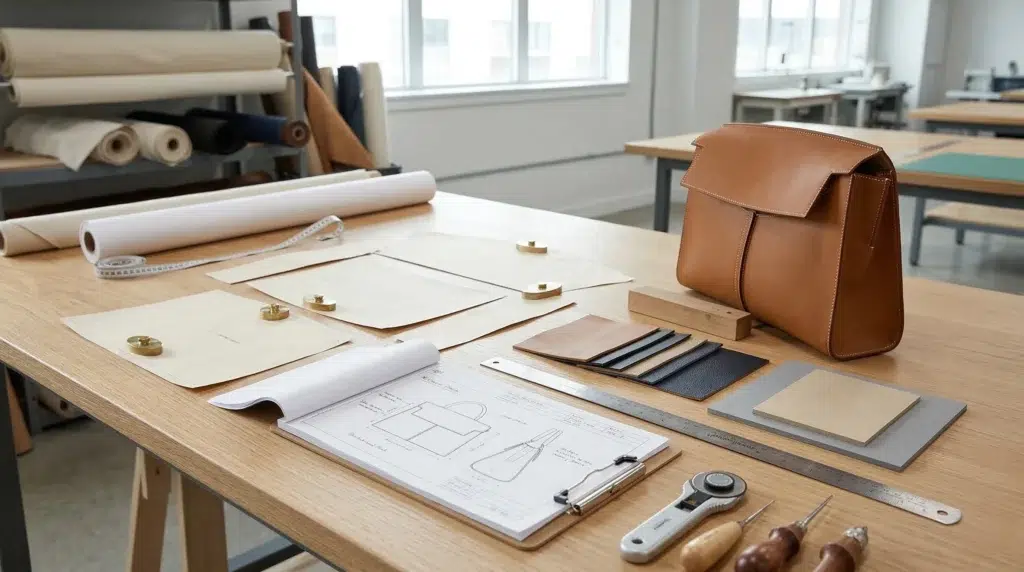
A better approach is to first convert the 2D concept into a manufacturable development package. This is usually done by an experienced handbag pattern maker, development technician, or factory team who understands structure, materials, and construction logic.
A proper tech pack for handbag development should clearly define at least:
- main dimensions and proportions
- material type and thickness range
- internal reinforcement method
- seam allowance and edge finishing method
- hardware placement
- reinforcement for key stress points
- opening and closure construction
- lining and interior configuration
For factories, an AI image can be a useful starting point. But it must be translated into a technical development document before a reliable sample can be made. Otherwise, even if the visual direction is correct, the finished sample may end up very different from the original image.
Before sampling, confirm:
- Does the bag shape depend on internal support materials?
- Is the hardware weight appropriate for the chosen body material?
- Have handle bases, strap roots, and lock areas been reinforced?
- Is there already a handbag tech pack or pattern available for execution?
Before Sending an AI Handbag Design to a Manufacturer, What Should Brands Prepare?
From our day-to-day factory experience, many projects do not fail because the idea is weak. They fail because the information provided at the beginning is incomplete.
A single AI-generated handbag image is usually not enough for a factory to accurately evaluate sampling feasibility, cost structure, or production method.
If a brand wants a smoother development process, it helps to provide the following information as early as possible:
- target retail price range
- expected sample quantity and initial order quantity
- preferred material type, such as genuine leather, PU, canvas, or recycled material
- whether custom hardware is necessary
- whether dimensions, reference samples, patterns, or a tech pack already exist
- whether the project is for concept validation only or intended for future bulk production
The clearer this information is, the easier it is for a handbag manufacturer to identify which design elements can be preserved and which details may need adjustment for cost, structure, or production efficiency.
Conclusion: AI Can Generate Creative Direction, but Manufacturability Determines Whether the Product Can Really Be Made
AI tools are changing the early stages of fashion product development. They help brands and designers explore concepts faster, generate visual options more efficiently, and communicate aesthetic direction more clearly.
But there is still a major gap between a concept image and a handbag that can be sampled, costed, produced consistently, and delivered at scale.
In handbag manufacturing, that gap is filled by material logic, construction planning, hardware strategy, cost control, and structural problem-solving. No matter how attractive the concept image is, these production questions still need to be resolved before the design can become a real product.
For brands, the most efficient development path is not to move directly from AI artwork to production. It is to evaluate manufacturability first: which features should be kept, which details should be optimized, and which visual ideas need to be translated into more practical production solutions.
If you are using AI-generated handbag concepts and planning to develop samples, it is worth discussing the design with a manufacturing team as early as possible. The earlier the structure, materials, hardware, and cost assumptions are aligned, the lower the risk of budget surprises, repeated sample revisions, and production issues later.
FAQ: AI Handbag Design, Sampling, and Manufacturing
Can AI-generated handbag designs be used directly for sampling?
Usually not. AI images can be useful for concept development, but they are not technical manufacturing documents. Before sampling, the design normally needs to be translated into a workable handbag tech pack, pattern, or development specification that includes dimensions, materials, construction details, hardware placement, and reinforcement methods.
Why do AI handbag concepts often become expensive to produce?
Because AI focuses on visual effect, not manufacturing cost. It may generate multiple custom embossed details, complex multi-color printing, unusual hardware shapes, or unrealistic structures without considering tooling charges, labor complexity, material limitations, or minimum order quantity requirements.
Do all custom handbag hardware parts require new molds?
Not all hardware needs custom tooling, but non-standard shapes usually do. In handbag manufacturing, brands often save cost by customizing only the most visible signature hardware while using high-quality standard hardware for more functional components.
What is the biggest risk when developing a handbag from an AI concept?
One of the biggest risks is assuming that a visually attractive image is already production-ready. In reality, structure, material thickness, internal support, hardware weight, and stress-point reinforcement all need to be evaluated before sampling.
What should a brand send to a handbag manufacturer before requesting a quote?
In addition to the concept image, it is helpful to provide target retail pricing, expected order quantity, preferred materials, whether custom hardware is required, reference dimensions, and any available tech pack or sample reference. This allows the factory to evaluate cost and manufacturability more accurately.
What is included in a handbag tech pack?
A handbag tech pack usually includes core dimensions, material specifications, thickness requirements, hardware details, color references, reinforcement methods, stitching or edge-finishing instructions, construction notes, and other information needed for sampling and production.
Is AI useful in handbag development at all?
Yes. AI can be very useful in the concept stage. It helps brands explore design direction quickly and communicate visual ideas more efficiently. The key is understanding that AI is best used as a starting point, not as a replacement for technical development and manufacturing evaluation.