


OEM vs ODM Handbag Manufacturing: Which Model Fits Your Business?
For many brands, wholesalers, and private label buyers, one of the first questions in handbag sourcing is whether to choose OEM or ODM manufacturing.
At a basic level, the difference sounds simple. But once a real project begins, the conversation quickly becomes more practical. Buyers start asking about MOQ, sample costs, materials, logo customization, hardware changes, and whether a product can be developed from only a picture. At that stage, OEM and ODM are no longer just industry terms. They shape how the project is developed, how long sampling takes, and how easily an idea can move into production.
This is especially true in handbag manufacturing. Compared with simpler product categories, handbags involve more decisions around materials, structure, hardware, lining, logo treatment, and finishing details. A small adjustment that looks simple to the buyer may have a very different impact on the development process depending on what is being changed.
That is why the choice between OEM and ODM matters. The right model depends not only on what kind of bag you want to make, but also on how much originality you need, how much flexibility you want, and how ready you are to move from concept into production.
As a senior salesperson from a handbag manufacturer, I will explore the real differences between OEM and ODM handbag manufacturing, common misconceptions among buyers, and how to more effectively determine which model is better suited to your business.
Understanding OEM in Handbag Manufacturing
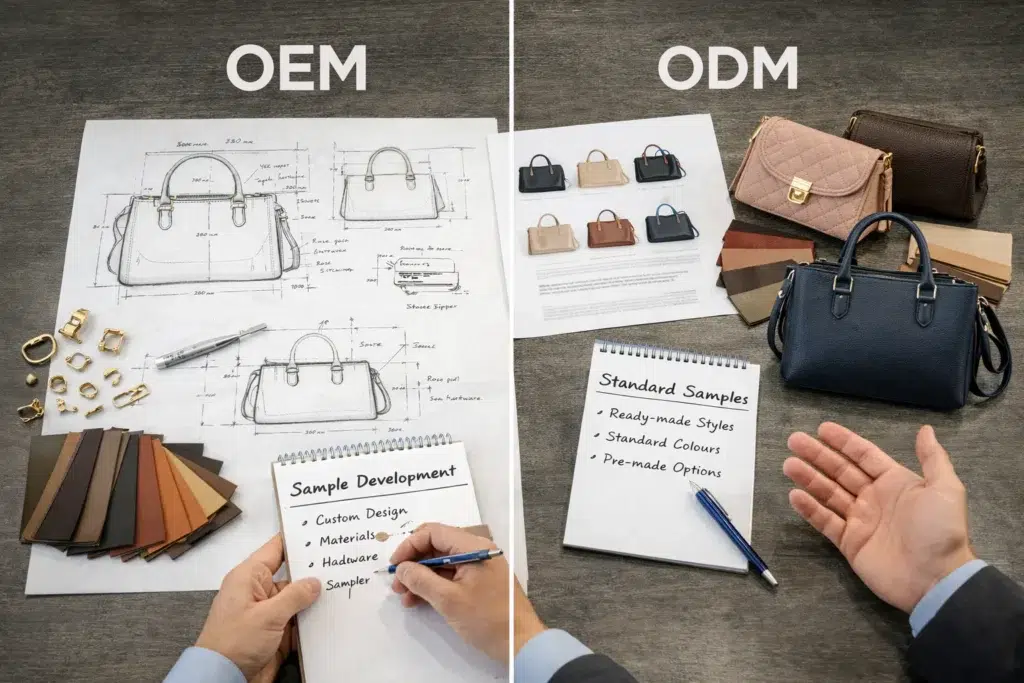
OEM, or Original Equipment Manufacturing, usually means the buyer has their own design direction and wants the manufacturer to produce according to that idea.
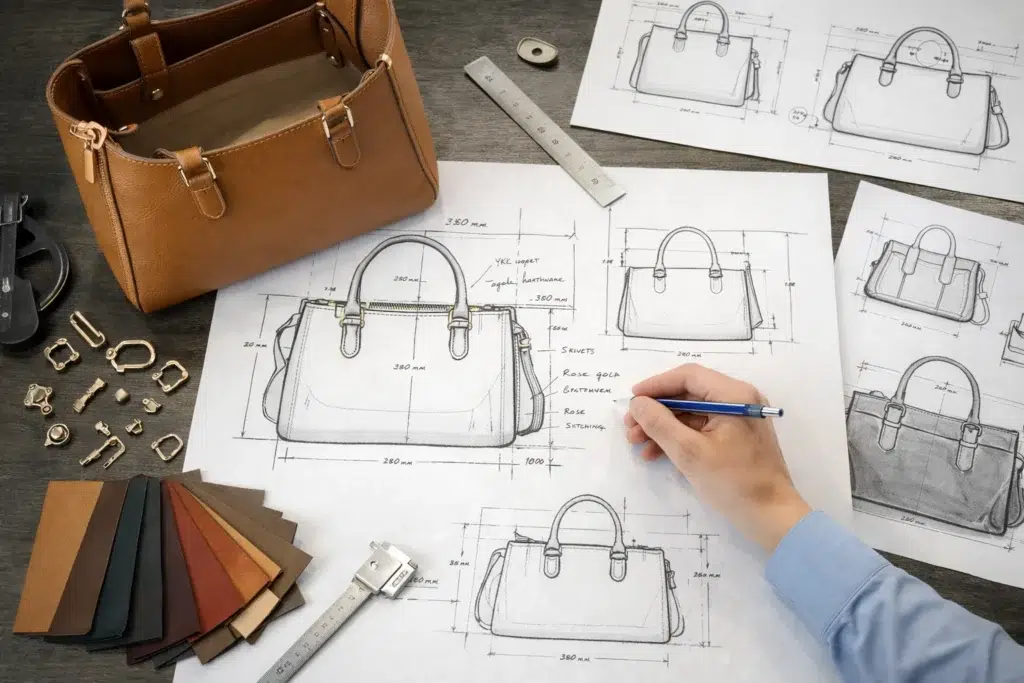
In real handbag projects, that design input can take different forms. Some buyers provide a full tech pack with detailed specifications. Others only have sketches, reference images, or photos of a style they want to develop. In many cases, that is enough to start. If the design direction is clear, a manufacturer can often help turn the buyer’s idea into a workable technical package and move the project into sampling.
This is an important point because many newer buyers assume they must prepare complete technical files before approaching a factory. In practice, that is not always necessary. If the buyer has a clear product idea, even in the form of pictures, OEM development can still move forward with the right support.
For this reason, OEM is often a strong fit for brands that want more control over their products. It allows them to define the look, feel, materials, logo treatment, and overall positioning of the bag more clearly.
In our own work, one of the simplest ways to identify an OEM project is to ask whether the customer already has their own design. If the answer is yes, then the project is usually best handled as OEM.
Understanding ODM in Handbag Manufacturing
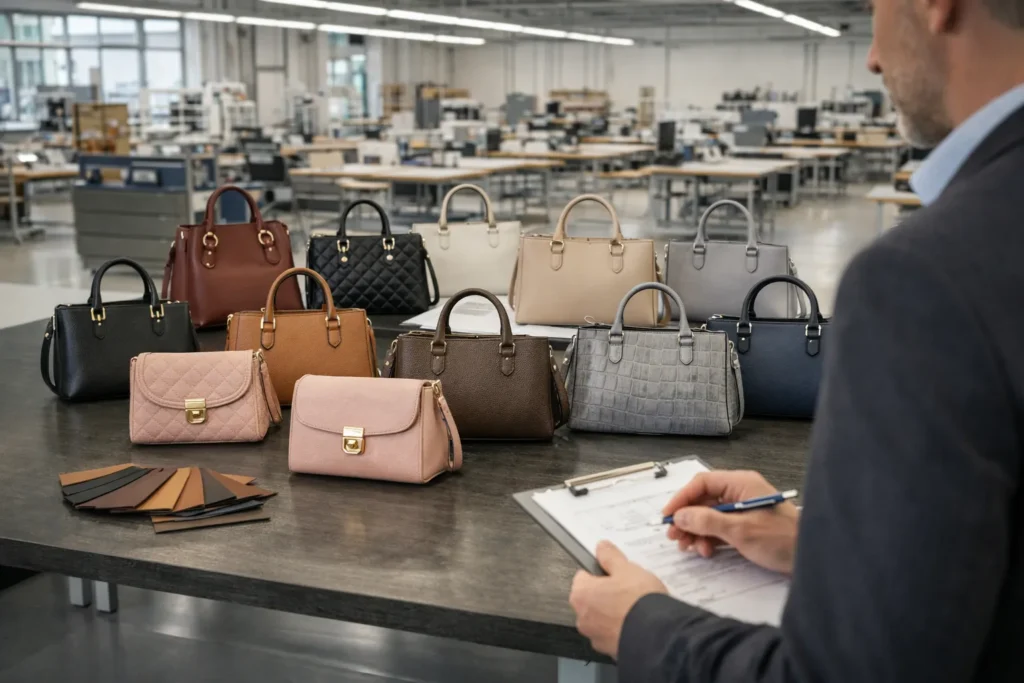
ODM, or Original Design Manufacturing, refers to a model where the manufacturer already has existing designs or product structures, and the buyer selects from those options instead of starting with a completely original concept.
This model is often more efficient because the basic development work has already been done. Buyers can start from an existing style and then make selected adjustments depending on the factory’s capability and the scope of customization allowed.
ODM is especially useful for buyers who want to shorten development time, simplify decision-making, or enter the market with lower risk. For businesses that are still testing demand or building an initial collection, it can be a very practical option.
At the same time, many buyers underestimate how flexible ODM can be. It does not always mean taking a standard product exactly as it is. In some cases, ODM projects can still be customized and even manufactured on an exclusive basis, depending on the cooperation model.
That is why ODM continues to be relevant for many handbag buyers, especially when speed and manageable starting quantities matter.
The Difference Is Not Just About Definitions
The standard explanation is that OEM starts with the buyer’s design, while ODM starts with the manufacturer’s existing design. That is true, but in real projects the difference becomes clearer when buyers begin making changes.
Many customers assume that any modification automatically turns a project into OEM. In practice, that is not always how development works.
For example, changing hardware does not necessarily make a project OEM. Buyers often focus on visible details and assume every change carries the same development meaning, but that is not the case. Some changes are relatively straightforward, while others affect sourcing, production planning, and sample development much more directly.
Material changes and logo customization, for example, often carry more weight because they affect not only the appearance of the bag, but also the way the product is developed and positioned. This is where buyers begin to see that handbag manufacturing is not simply about changing one detail at a time. It is about understanding how different requests affect the project as a whole.
That is why the OEM versus ODM discussion is best understood as a development decision, not just a label.
Why OEM Appeals to More Buyers Than Many People Expect
For many brands, OEM is appealing because it offers more control. But in today’s market, it also appeals for another reason: flexibility.
Many smaller or early-stage brands assume OEM is only for bigger buyers with large quantities. In reality, that depends on the manufacturer. If a factory can support lower minimums, OEM becomes much more accessible for new businesses than many people expect.
This matters because a growing number of brands do not want to begin with generic products. Even in the early stages, they want their own design direction, their own branding, and their own product identity. They may not need highly complex luxury-level development, but they do want products that feel like their brand from the start.
That is one reason low-MOQ OEM support can be valuable. It allows a younger brand to begin with its own design concept without taking on the same level of risk that larger order requirements usually create.
For startups, especially those selling into European and North American markets, this can make a real difference. Buyers in these markets often pay attention to material feel, logo detail, silhouette, and overall product presentation. OEM gives brands more room to shape these details in a way that fits their target audience.
Why ODM Still Has Its Place
Although OEM can be attractive, ODM still makes sense for many businesses.
Some customers are not ready to start with their own design. Others need to test a category first, launch quickly, or reduce the number of development decisions they need to make at the beginning. In those situations, ODM is often the more efficient route.
For example, a buyer who wants to try a style category before making a larger investment may be better served by starting from an existing structure. That can reduce uncertainty and make it easier to move into production.
ODM can also be useful when a customer wants quicker product turnaround or is still learning what their market responds to. For these buyers, speed and practicality may matter more than starting from a completely original concept.
The point is not that one model is always better. The better model is the one that fits the current business stage.
What Buyers Ask Most Often
In actual handbag manufacturing discussions, buyers usually do not begin by asking theoretical questions about OEM and ODM. They ask practical questions that affect budget, timing, and feasibility.
Two of the most common are MOQ and materials.
MOQ matters because many new or growing brands do not want to begin with a large production commitment. They want to test the market, control inventory risk, and manage cash flow carefully. For that reason, lower minimums can be a major advantage when a buyer is deciding whether to move forward.
Materials matter because they influence cost, product positioning, and target market appeal. In handbag manufacturing, buyers often compare options such as vegan PU leather, genuine leather, and other material combinations depending on the brand image and price level they want to achieve.
Another very common question is whether a bag can be made if the customer only has pictures. In many cases, the answer is yes. If the design direction is clear, development can often begin from reference images and then be translated into technical requirements for sampling and production.
These kinds of questions are important because they show how buyers actually think. Most are not trying to choose between terms. They are trying to understand whether their idea is realistic, affordable, and ready for production.
One of the Biggest Misunderstandings: Sample Pricing
One of the most common misunderstandings in handbag development is the idea that all samples should cost the same.
From the buyer’s point of view, a sample is just the first version of a bag. But from the manufacturer’s point of view, sample cost depends on what is being developed.
A simple sample without complex decoration, custom logo hardware, or special material sourcing is not the same as a sample that includes a more complicated pattern, multiple custom details, or specially developed metal accessories.
This is why sample fees are usually based on the design itself, the materials being used, and the degree of customization involved. A more complex product naturally requires more development work, more coordination, and sometimes more sourcing effort.
Buyers who understand this early usually communicate more effectively with manufacturers. Instead of expecting a uniform sample price for every design, they begin to see sampling as part of product development rather than as a fixed administrative step.
Sampling Timelines and Revision Expectations
Sampling is where a handbag idea becomes tangible, but it is also where expectations need to be realistic.
A standard sample timeline often falls around 7 to 15 working days, depending on the design and the materials involved. However, this timeline is not absolute. If the project includes special custom hardware, additional development time is often required.
This is another area where buyers can misjudge the process. A change that looks small on paper may still affect sourcing or development time. Custom metal logo hardware is a good example. It may seem like a single detail, but it can add complexity to the project.
As for revisions, many OEM projects can move through one sample round if the design direction is clear and the requested changes are limited. But once the customer begins changing the design after seeing the first sample, a second round or additional rounds are often needed. That is a normal part of development, not a sign that something has gone wrong.
The key point is that sampling is not just for checking appearance. It is part of refining the product into something production-ready.
How We Usually Judge Whether a Project Should Be OEM or ODM
In theory, the difference between OEM and ODM can be described in many ways. In practice, our first step is often much simpler: we ask whether the customer already has their own design.
If the customer has their own design direction, reference, or concept they want to develop, we usually treat the project as OEM.
That approach works well because it reflects how real projects begin. Buyers who come with their own design usually want more control over the product and expect the development process to follow their brand direction. Buyers who prefer to start from existing styles are often better suited to ODM, especially if their priority is faster decision-making or a simpler starting point.
This is not about making the process more complicated than necessary. It is about choosing the model that best matches the customer’s actual starting position.
Why Low-MOQ OEM Matters for New Brands
One reason many young brands hesitate to pursue OEM is the assumption that it requires a large order quantity and a large budget from the beginning.
But if a manufacturer can support OEM with lower minimums, that changes the equation.
For new brands, especially those just entering the market, being able to start from a smaller quantity can make original product development much more realistic. It allows them to test their own design direction without taking on the pressure of a high-volume first order.
This is where low-MOQ OEM can create real value. It gives smaller brands a chance to build their own collection identity early, rather than waiting until they are larger to begin serious product development.
We have seen this matter in real business. One U.S. brand we supported started with just 50 pieces per style in the beginning. As the brand grew, that volume increased to around 200 pieces per style. That kind of growth is a good example of why flexible manufacturing support matters. For a young brand, the right starting point is not always a large order. Sometimes it is a manageable order that allows the business to grow steadily and confidently.
Final Thoughts
OEM and ODM handbag manufacturing are often explained as two simple categories, but real sourcing decisions are rarely that simple.
What matters most is not only what the project is called, but how it is being developed, how much customization is required, and what stage the buyer’s business is currently in.
If a customer already has their own design, wants more control, and is building a clearer brand identity, OEM is often the better fit.
If a customer wants to move faster, reduce complexity, or start from an existing style, ODM may be the more practical option.
In the end, the right manufacturing model is the one that aligns with the product idea, development expectations, and business goals behind the project.
Closing Note
For many buyers, especially newer brands, the decision between OEM and ODM becomes much easier once a few priorities are clear: design ownership, materials, minimum quantity, sample expectations, and launch timing.
Once those points are defined early, communication becomes smoother, sampling becomes more efficient, and the production path becomes much easier to manage.
If you are planning a handbag project, clarifying your design direction, material needs, and target order quantity early can help you choose the right manufacturing model more efficiently.